
Quick answer
Dental SEO is the process of getting a practice’s website to rank higher on Google so more local patients find and book with it. It works across three pillars — technical SEO, on-page and content, and local and off-page — and in 2026 it also means showing up in map results and AI Overviews. Done properly, dental SEO turns Google into a predictable source of new patients rather than a vanity ranking exercise.
Search is where most patients now choose a dentist. Before they ever call, they type a treatment and a town into Google, glance at the map results, skim reviews, and click one of the first names they see. Dental SEO is how you make sure that name is yours. This guide explains what dental SEO actually involves, why it matters more than ever in 2026, and how the pieces fit together to bring in patients.
What is dental SEO, in plain English?
Dental SEO is everything you do to help search engines understand, trust, and rank your practice. It breaks into three pillars:
- Technical SEO: the foundation — site speed, mobile performance, crawlability, and dental schema markup so Google knows you’re a local dental practice.
- On-page and content: treatment pages and blog content optimised for the words patients actually search, from “dental implants” to “emergency dentist”.
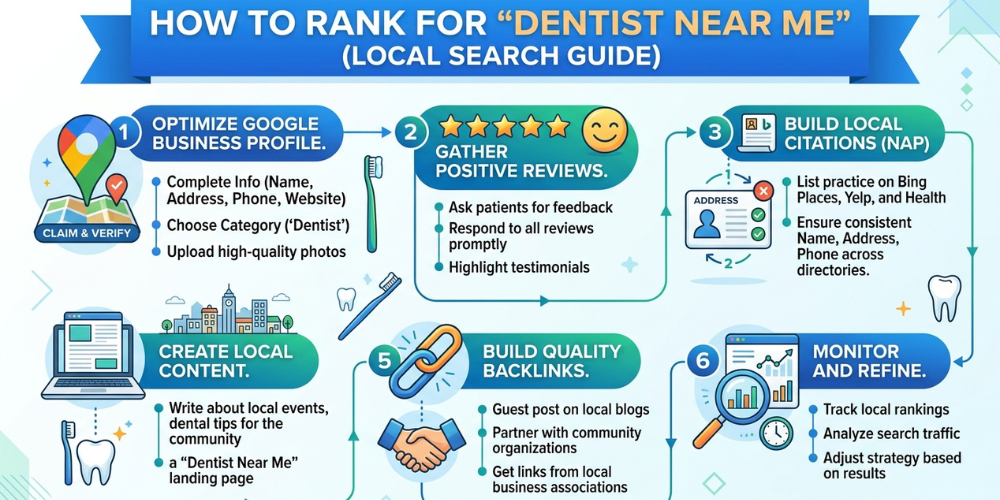
- Local and off-page: your Google Business Profile, citations, reviews, and links — the signals that decide whether you appear in the local map pack.
Get all three working together and Google rewards you with visibility exactly when a patient is ready to book. Our dental SEO services are built around these three pillars.
Why can’t UK dentists ignore SEO in 2026?
Because patient behaviour has moved and competition has intensified. A few shifts every practice owner should know:
- Search is the first step: the vast majority of patients research online before choosing a dentist, and most never look past the first page.
- AI Overviews now sit above the results: Google increasingly answers “best dentist in [town]” with an AI summary, and practices with strong SEO get pulled into it.
- Competition is per-postcode: you’re not competing with every dentist in the UK, you’re competing with the handful near you — which is winnable with focused SEO.
Treated as a growth channel rather than a cost, SEO compounds: the work you do this quarter keeps returning patients for years.
How does the technical foundation work?
Search engines have to be able to crawl, understand, and trust your site before they’ll rank it. The essentials for a dental practice are a fast, mobile-friendly website, clean site structure, and correct schema markup (Dentist and LocalBusiness types) that spells out your name, address, services, and opening hours. Most practice websites have at least one technical issue quietly holding them back — which is exactly what an audit uncovers.
Most dental sites have hidden technical faults dragging their rankings down. Get a free audit and we’ll show you exactly which ones are costing you patients — and how to fix them.
What about on-page and treatment pages?
Every treatment you want more of deserves its own optimised page. Map one primary keyword to each — implants, Invisalign, whitening, emergency care — and get the title, H1, and meta description right, with genuinely useful content underneath. This is what lets you rank for high-value treatments instead of only your practice name.
How does local SEO fit in?
For a dentist, local is where the leads are. The map pack — those three local results with the map — sits above the normal listings and captures most of the clicks. Ranking there comes down to a fully optimised Google Business Profile, consistent citations, and a steady flow of reviews. We cover this in depth in how to rank in Google’s map pack.
How do you measure the return on dental SEO?
Judge SEO on patients, not positions. The metrics that matter are calls, form fills, and booked appointments traced back to organic search — then the value of the treatments those patients need. Rankings and traffic are only useful insofar as they turn into enquiries. And because search is changing, it’s worth making sure you also show up in AI results, where more patients are starting their search. To see what this level of work costs, read how much dental SEO costs.
Stop guessing why competitors outrank you. Get a free dental SEO audit and a clear, prioritised action plan — no obligation, no jargon, just the gaps and the fixes.
Frequently asked questions
How long does dental SEO take to work in the UK?
Typically 3 to 6 months for meaningful movement, though local map-pack results can come faster in lower-competition areas.
Is SEO or PPC better for a dental practice?
PPC buys leads today; SEO compounds and lowers your cost per patient over time. Most growing practices run both together.
What is dental SEO?
Dental SEO is the work of improving a practice’s website and online presence so it ranks higher on Google and attracts more local patients, across technical, on-page, and local signals.
Can a dental practice rank without paying for ads?
Yes. Strong organic and local SEO can win the map pack and first-page rankings without ad spend, though it takes longer to build than paid ads.