Quick answer
To get more Google reviews, a dental practice should ask every happy patient at the right moment, make leaving a review effortless with a direct link, and respond to every review — all without offering incentives, which breaches GDC and ASA rules. Reviews drive both local rankings and bookings, so a simple, consistent, compliant system is one of the highest-return things a practice can build.
Reviews are the rare marketing asset that lifts your rankings and wins the booking at the same time. A patient comparing two practices almost always picks the one with more, better, and more recent reviews. The good news is that getting them is a system, not luck — and this guide lays out a compliant one that works.
Why do reviews drive both rankings and bookings?
Because they do double duty. To Google, review volume, recency, and rating are local prominence signals that help you rank in the map pack. To patients, they’re social proof — the deciding factor when choosing between practices that look otherwise similar. Improve your reviews and you lift visibility and conversion in one move.
What’s the ask that actually works?
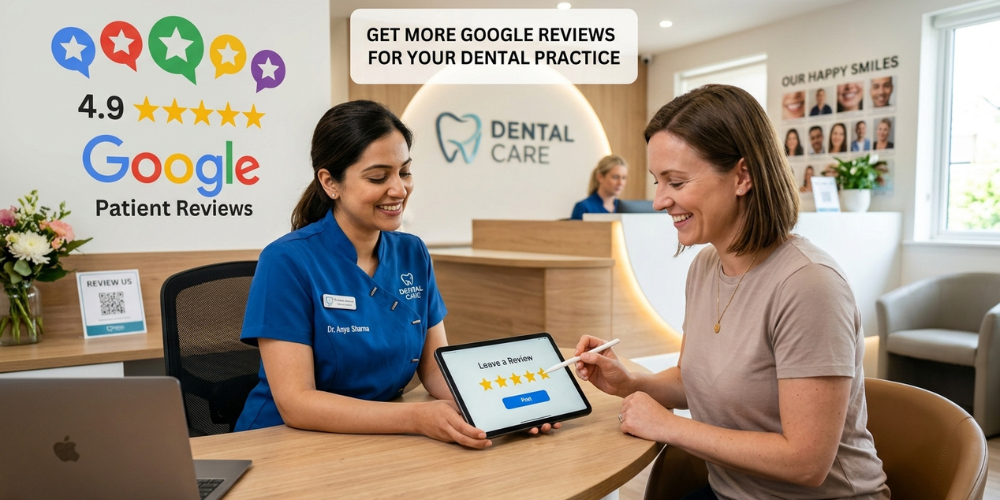
Timing and simplicity win. Ask when the patient is happiest — right after a positive appointment or a completed treatment. Use whichever channel fits your practice:
- Chairside: a warm personal ask from the clinician or receptionist.
- SMS or email: a short follow-up with your direct review link.
- QR code at reception: a quick scan while they’re still with you.
How do you make leaving a review frictionless?
Every extra step loses reviews. Use your practice’s direct Google review link so patients land straight on the review box, add one line of instructions, and give reception a simple script so the ask is consistent. The easier you make it, the more reviews you get.
Struggling to turn happy patients into public reviews? Get a free audit and we’ll design a review system that runs on autopilot — compliant, and built to lift your rankings.
How should you respond to reviews?
Reply to all of them. For positive reviews, a short, warm thank-you (mentioning the treatment or area naturally) reinforces your local relevance. For negative reviews, stay calm and professional, take it offline, and never disclose any clinical or personal details — that’s both a GDPR and a GDC requirement. A practice that responds well looks trustworthy to every future patient reading along.
What should you never do?
- Buy reviews — fake reviews breach Google’s policies and can get you penalised.
- Incentivise reviews — offering discounts or freebies for reviews breaks GDC and ASA rules.
- Gate reviews — filtering so only happy patients can post is against Google’s guidelines.
Reviews are one of the strongest levers in ranking in the local map pack, and they work hand in hand with a well-run profile — see how to optimise your GBP. For a fully managed approach, explore our Google Business Profile management service.
More reviews, more patients, higher rankings — without lifting a finger. Get a free audit and we’ll build a review engine that keeps the 5-stars coming.
Frequently asked questions
Can dentists ask patients for Google reviews in the UK?
Yes, asking is fine — but you can’t offer incentives, and your replies must never disclose patient or clinical details.
Do Google reviews help dental SEO?
Yes. Review volume, recency, and rating are local ranking signals and strongly influence whether patients click and call.
How do I get more Google reviews for my dental practice?
Ask every happy patient at the right moment, make it effortless with a direct review link, and respond to every review — without incentives.
Can I offer a discount for leaving a review?
No. Incentivising reviews breaches GDC and ASA rules and Google’s policies, and can undermine trust in your profile.