Quick answer
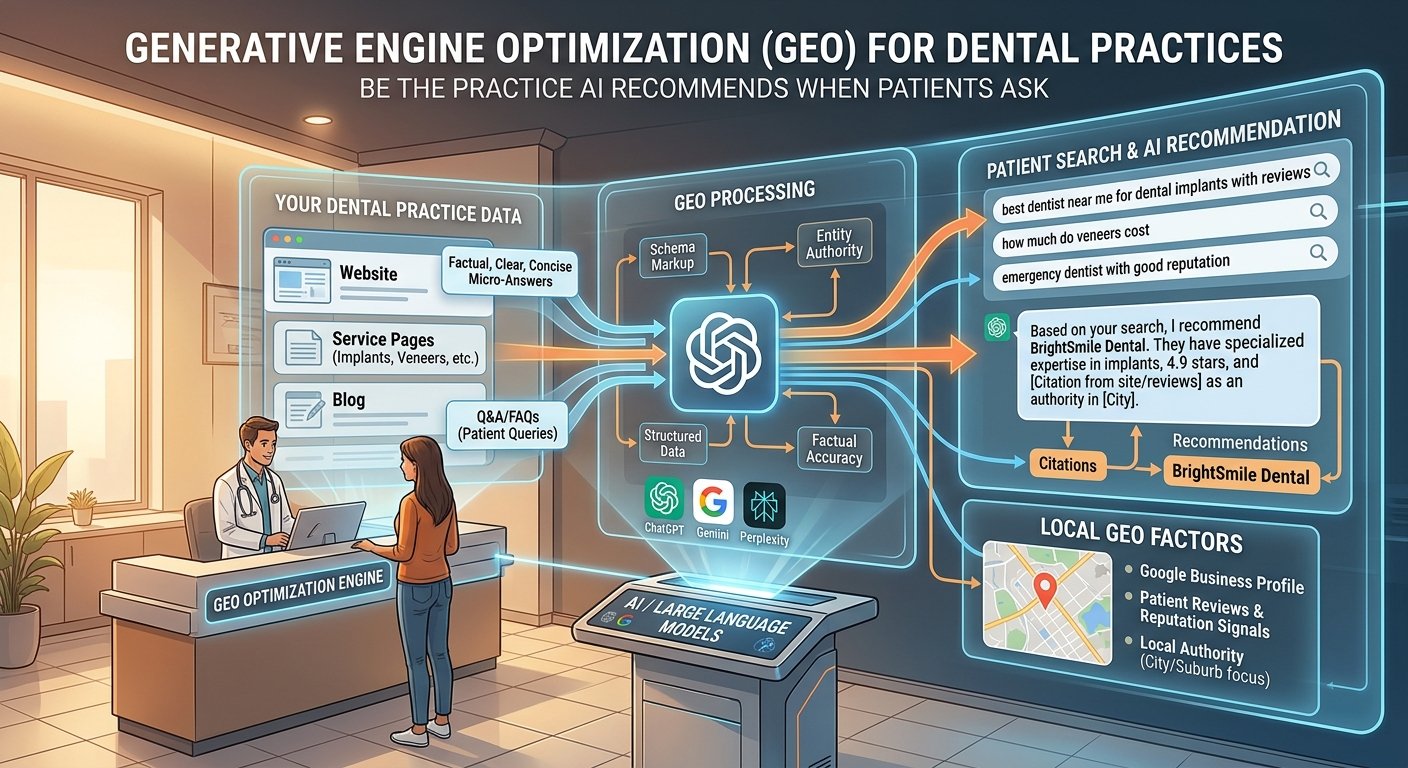
Generative Engine Optimisation (GEO) is the practice of optimising your content and entity data so AI engines cite you in their generated answers. For a dental practice, GEO means answer-first content, clean schema, consistent business details, and earning references on trusted sites — so that when a patient asks an AI for a recommendation, your practice is the one it names. Competition is low today, which makes early movers hard to displace later.
SEO got you ranked in a list of links. GEO gets you named inside an AI’s answer. As patients increasingly ask ChatGPT, Gemini, and Google’s AI Overviews for recommendations, the practices that understand generative engine optimisation now will be the ones AI keeps citing for years. This post defines GEO clearly and turns it into concrete actions for a dental practice.
GEO vs SEO vs AEO: what’s the difference?
They overlap, but each has a focus:
- SEO (Search Engine Optimisation): ranking your pages in the traditional list of Google results.
- AEO (Answer Engine Optimisation): structuring content to win featured snippets and direct answers.
- GEO (Generative Engine Optimisation): getting your practice cited inside AI-generated answers from tools like ChatGPT and Gemini.
They share foundations — good content, clean structure, trust — but GEO adds an emphasis on entity clarity and being quotable. Get all three working and you’re covered whether a patient uses Google, a snippet, or an AI chatbot.
How do generative engines choose their sources?
AI engines favour sources they can trust and parse. The signals that matter most:
- Authority: is your practice established and referenced elsewhere?
- Structure: is your content clean, well-marked-up, and easy to extract?
- Freshness: is the information current?
- Entity clarity: is your identity consistent and unambiguous?
- Corroboration: do multiple trusted sources agree on your details?
What’s the GEO playbook for dentists?
- Answer-first content: lead every page with a direct, quotable answer to the question patients ask.
- Schema markup: mark up your practice, services, and FAQs so engines read them cleanly.
- FAQs: build out real patient questions with concise answers.
- Consistent NAP: identical name, address, and phone everywhere you appear.
- Earn citations: get referenced on directories, local press, and trusted health and local sites.
Where is GEO heading?
Towards being the default way people find services. As AI answers replace more link-clicking, being the cited practice becomes as valuable as ranking number one used to be. Practices that build their GEO foundations now — while rivals ignore it — earn a lead that compounds. It’s a core part of a modern dental marketing strategy, and it sits alongside AI SEO for dentists and knowing what AI says about your practice. For hands-on help, see our AI SEO services.
Frequently asked questions
What is GEO in marketing?
Generative Engine Optimisation — optimising your content and entity data so AI engines cite your practice in the answers they generate.
Is GEO worth it for a small dental practice?
Yes. Competition is low right now, so early movers get referenced by AI before their rivals do, and that lead is hard to overturn.
What’s the difference between GEO and SEO?
SEO ranks your pages in traditional search results; GEO gets your practice named and cited inside AI-generated answers.
How do dentists get cited by AI engines?
Through answer-first content, clean schema, consistent business details, and earning references on trusted third-party sites.